
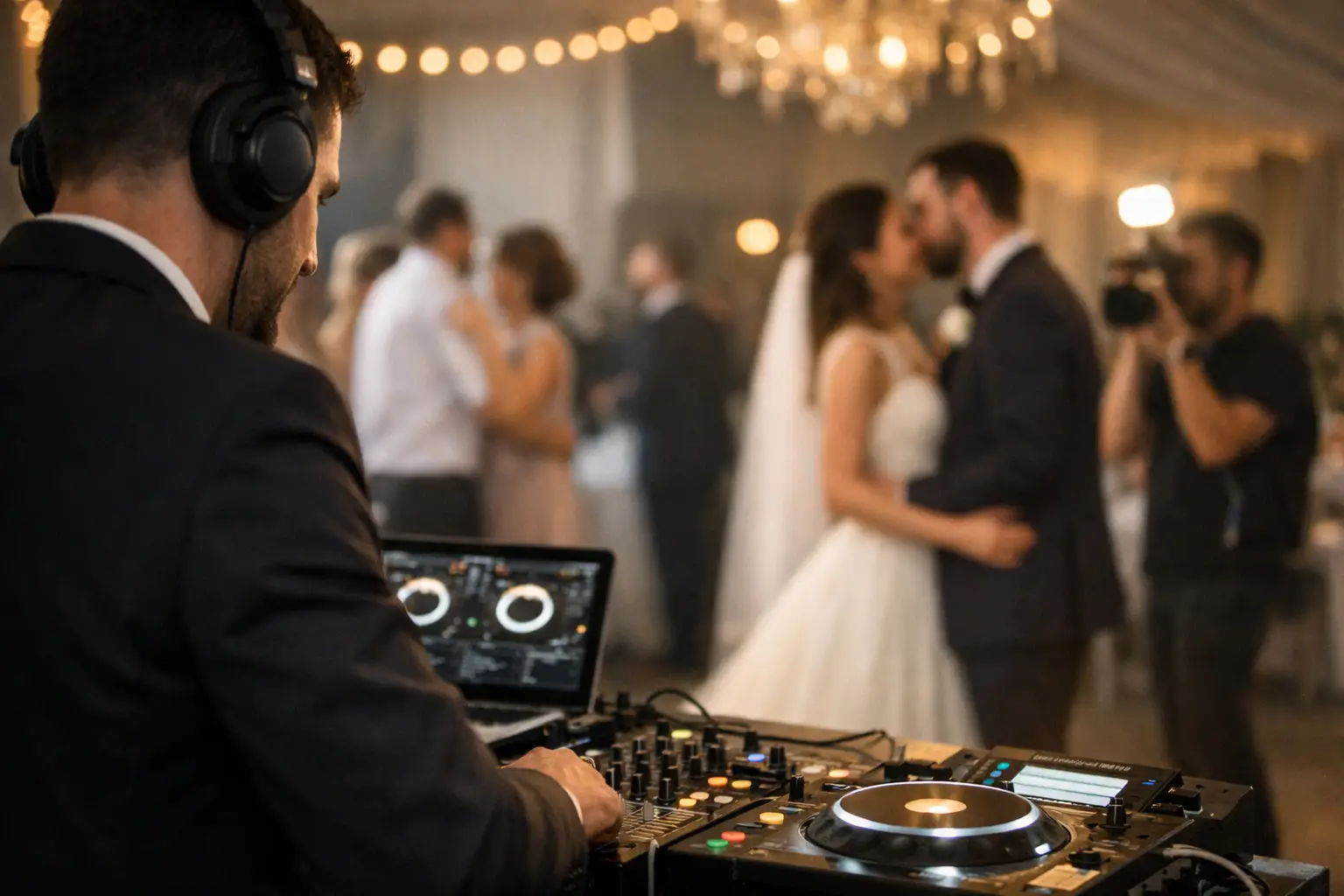
The moment your guests walk into the room, the music is already doing quiet work. It sets the temperature of the day before anyone has taken their seat, lifts nervous energy, and tells people whether this wedding will feel elegant, lively, romantic, relaxed – or all four at the right times. If you have ever wondered what does wedding DJ do, the answer is much broader than playing a few favourite tracks and pressing start.
Most couples are surprised by how much a professional wedding DJ actually does on the day. Read on to find out — and when you’re ready to dig deeper, see our guide on how DJ services shape the entire day, what creates a premium wedding DJ experience, and DJ lighting and sound systems explained.
A wedding DJ is part music curator, part atmosphere manager, part planner, and part behind-the-scenes professional who helps the day feel polished from one moment to the next. At a well-run wedding, that work often goes unnoticed – and that is usually the sign it is being done properly.
What does a wedding DJ do before the wedding?
Long before the first dance, a wedding DJ is shaping how the celebration will feel. This is where the difference between a specialist wedding DJ and a general party DJ becomes very clear.
A strong wedding DJ begins with planning. That means understanding the couple, the style of the day, the venue, the guest mix, and the moments that matter most. Some couples want a refined drinks reception that gradually builds into a packed dance floor. Others want a classic dinner-to-dancing flow with a warm, romantic atmosphere early on and real energy later in the evening. The music needs to support that journey rather than fight against it.
This planning stage usually includes discussions around key songs, musical tastes, genres to include, tracks to avoid, and the overall tone of the celebration. It may also involve timeline coordination, so the DJ knows when guests will arrive, when speeches are due, when the cake is being cut, and when the evening reception properly begins. The more tailored the process, the more natural the day feels.
For couples who value a personalised experience, this matters. A wedding should not sound borrowed from somebody else’s event. It should feel like your relationship has a soundtrack.
Music curation is only part of the job
Yes, choosing and mixing music is central. But the real value lies in knowing what to play, when to play it, and when not to.
A wedding DJ curates music for each part of the day. Background music for a drinks reception needs a different touch from music during dinner. The first dance needs emotional weight. The transition into party mode needs confidence and timing. Later in the evening, the music often becomes more responsive – shaped by who is dancing, what is landing well, and how the room is feeling.
This is where experience matters. A good wedding DJ does not simply work through a fixed playlist. They read the room. They notice when guests are ready for a lift in tempo, when a change in style would bring more people onto the dance floor, or when the moment calls for a familiar anthem rather than something niche.
At the same time, they are balancing your preferences with guest enjoyment. That can be a delicate line. A completely guest-led set may lose your personality, but a completely personal playlist can sometimes leave the dance floor flat. The best wedding DJs know how to honour both.
What does wedding DJ do during the wedding itself?
During the wedding, the DJ’s role becomes more visible, even if much of it still happens quietly.
First, they arrive to set up properly and test equipment well before guests are in the room. That includes sound levels, speaker placement, microphone checks, lighting control, and making sure the setup suits the venue rather than dominating it. At a premium wedding, this detail matters. Crisp audio for speeches, balanced volume during dinner, and elegant lighting all shape the guest experience.
Then there is the flow of the event. A wedding DJ often helps connect one part of the day to the next. That might mean lowering background music for announcements, cueing a key entrance, preparing microphones for speeches, adjusting the atmosphere after dinner, or building momentum before the first dance. If these moments feel smooth, it is rarely by accident.
A specialist DJ is also watching the room constantly. Are guests still talking happily over dinner, meaning the music should stay subtle? Has the bar reopened and the energy changed? Are older relatives enjoying the floor early on, suggesting now is the moment for broad appeal? Is the couple ready for a fuller, more upbeat second half of the night? Reading these shifts is one of the most important parts of the job.
A wedding DJ helps manage energy, not just entertainment
One of the biggest misconceptions about wedding entertainment is that success is measured only by how full the dance floor looks at 10 pm. In reality, a great wedding DJ manages energy across the whole celebration.
That means understanding that not every moment should be high intensity. If every track pushes for maximum reaction, the evening can feel forced. Weddings need variation. Guests need space to talk, laugh, refill glasses, and then be drawn back into the atmosphere at the right time.
That rise and fall is what gives the celebration shape. The quieter moments make the big moments feel bigger. The romantic pause before the first dance makes it memorable. The careful shift from background music to dance floor favourites helps the evening feel like a natural progression rather than a sudden change of gear.
This is especially valuable for couples who want the day to feel elegant as well as fun. A wedding DJ should know how to create excitement without making the event feel chaotic.
Coordination with other suppliers matters more than couples realise
A wedding does not run in separate departments. Music, photography, catering, speeches, venue timings, and lighting all overlap.
An experienced wedding DJ works with the wider team to keep things moving smoothly. They may liaise with the venue over setup times, coordinate with photographers before the first dance, check timing with the catering team, or support the planner or toastmaster with announcements. That collaboration helps avoid awkward delays and gives the day a more refined rhythm.
This is one reason wedding expertise matters so much. Someone who is excellent at a birthday party or club night may still struggle with the pace and expectations of a wedding. Weddings are emotional, layered events with multiple generations in the room. They require judgement, timing, and a calm professional presence.
Equipment and presentation are part of the experience
Couples often focus on songs first, which is natural, but the technical side matters just as much.
A wedding DJ provides and manages sound and lighting equipment suitable for the venue and style of the event. That means reliable audio, clean microphone sound, and lighting that enhances the space rather than overwhelming it. In a luxury setting, presentation should feel considered and refined.
There is also a practical reason this matters. Poor sound can ruin speeches. Harsh volume can empty a dance floor. Unflattering lighting can change the whole feeling of a room. Good equipment, properly controlled, supports both atmosphere and comfort.
For couples planning in venues across Central Scotland, from elegant city spaces in Edinburgh and Glasgow to country house settings in Stirling, Fife or the Borders, this can vary from one room to another. A capable wedding DJ adjusts accordingly rather than applying the same setup everywhere.
Personalisation is what turns music into memory
The best wedding DJs do not just ask for a few requests. They build a musical picture of the couple.
That might include the songs tied to early dates, family favourites that matter for the dance floor, genres that suit the couple’s style, and tracks that should never make an appearance. A thoughtful planning process helps music feel emotionally connected to the day rather than randomly selected for convenience.
At Premier Disco Weddings, for example, couples can share music ideas through an online planning platform, which makes that process more collaborative and detailed. That level of preparation is often what allows the day itself to feel effortless.
Of course, there is always a balance. Too much detail can make the set rigid, while too little leaves too much to chance. The ideal approach gives the DJ enough direction to reflect the couple well, while leaving room to adapt in real time.
So, what does wedding DJ do?
They plan. They coordinate. They curate. They guide the atmosphere. They support key moments. They read the room. They manage transitions. They deliver the technical side properly. Most of all, they help a wedding feel coherent, personal, and alive from the first guest arrival to the final track of the night.
When couples choose a specialist wedding DJ, they are not simply booking someone to play music. They are choosing someone to shape how the celebration feels – and how it will be remembered.
If you are deciding what kind of entertainment your wedding needs, it helps to ask a slightly better question than what songs will they play. Ask how they will handle the mood, the timing, the personal touches, and the flow of the day. That is usually where the real difference is found.
See also: how DJ services shape the entire day, what creates a premium DJ experience, and DJ lighting and sound explained.
Want to see exactly what we do on your wedding day? Get in touch with Premier Disco Weddings.
Looking to experience exactly this level of professionalism at your wedding? See our full range of services — from our Evening Reception DJ to our Full-Day Wedding DJ & Host. Get in touch to discuss your day.
Frequently Asked Questions
What does a wedding DJ do during the ceremony?
For full-day packages, a wedding DJ manages all ceremony audio — microphones for the officiant, readers and any vocalists, plus music playback for the processional, signing of the register and recessional. They monitor levels throughout and ensure there are no feedback or sound issues during what is usually the most emotionally significant part of the day.
What does a wedding DJ do between songs during the reception?
A professional DJ is constantly working between tracks — monitoring the floor, planning the next three to five songs in sequence, adjusting levels, watching for energy shifts, fielding requests and deciding what to play and what to hold back. The visible act of playing a song is a small fraction of what is actually happening at the DJ booth.
Does a wedding DJ talk to guests during the reception?
A good wedding DJ makes announcements when needed — introducing the first dance, calling guests to dinner, announcing the buffet or bar closing time — but does not impose themselves on the evening unnecessarily. The music should do the talking. A DJ who talks too much interrupts the flow. A DJ who never speaks leaves guests without information they need.
What does a wedding DJ do if they get a bad request?
A professional DJ handles requests with tact. If a request fits the current mood and does not conflict with the couple’s do-not-play list, they will play it at an appropriate moment. If it would disrupt the floor or violates the couple’s preferences, they will acknowledge the request warmly without playing it. You should never hear a flat-out refusal that embarrasses a guest.
Leave a Reply
You must be logged in to post a comment.